Most homeowners underestimate how dramatically their zip code influences xeriscaping prices, with identical projects ranging from $8,000 in Phoenix to $14,000 in San Francisco. I’m going to walk you through the real numbers behind drought-tolerant landscaping, including where your money actually goes and how to avoid common budgeting pitfalls.
You’ll want to see what comes next.
Xeriscaping Cost Ranges: What Most Homeowners Pay
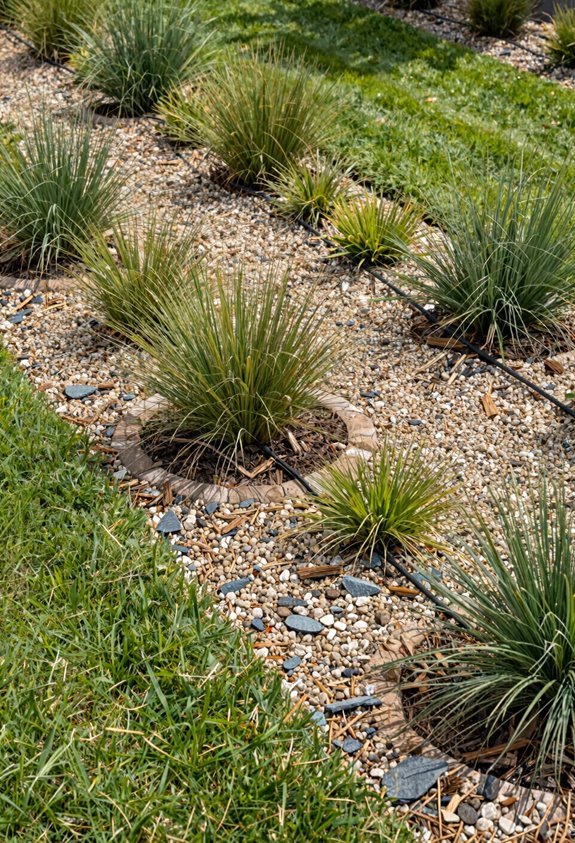
How much should you realistically budget to replace your water-hungry lawn with a water-wise landscape? I typically see xeriscaping costs fall between $5,000 and $15,000 for an average 1,000 square foot space, though your final number depends heavily on yard size and choices you make.
Your cost per square foot generally ranges from $5 to $20, with installation costs shaped by materials and design density. A simple approach using mulch and gravel keeps expenses modest, while boulders, trees, and detailed irrigation push figures higher. Labor runs $50–$100 hourly.
Most homeowners invest around $15,120–$18,400 for professional results. Factor in maintenance savings and water savings over time, and you’ll find this upfront commitment pays dividends. Your specific project scales with square footage and vision.
Cost Per Square Foot: Budget, Mid-Range, and High-End Breakdowns
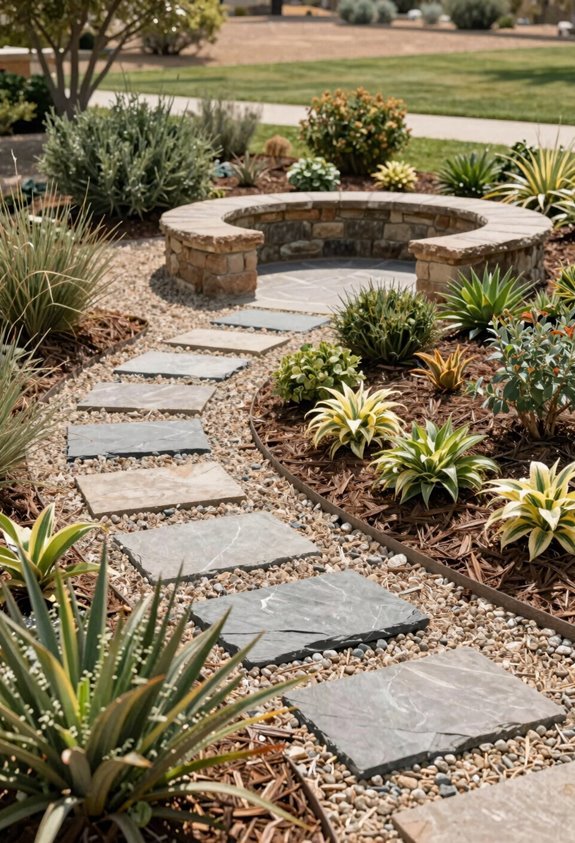
Why does per-square-foot pricing matter so much for your xeriscaping project? It gives you control, letting you scale your vision to match your reality.
Xeriscaping cost per square foot typically spans $5 to $20, creating clear cost ranges for every homeowner. On a budget, you’ll spend around $5 per square foot for basic materials and plants, simple layouts, and minimal hardscaping. Mid-range projects run $10 to $15 per square foot, adding better stone work, diverse native species, and professional design polish. High-end transformations reach $20 per square foot, featuring custom hardscaping, mature specimens, and intricate drainage.
Your square footage directly shapes where you land. A 500-square-foot space might cost $2,500 to $6,250 professionally, while DIY vs pro decisions swing totals dramatically. Think $983 DIY versus $3,500+ for the same footprint with expert hands.
How Yard Size Scales Your Total Xeriscaping Investment
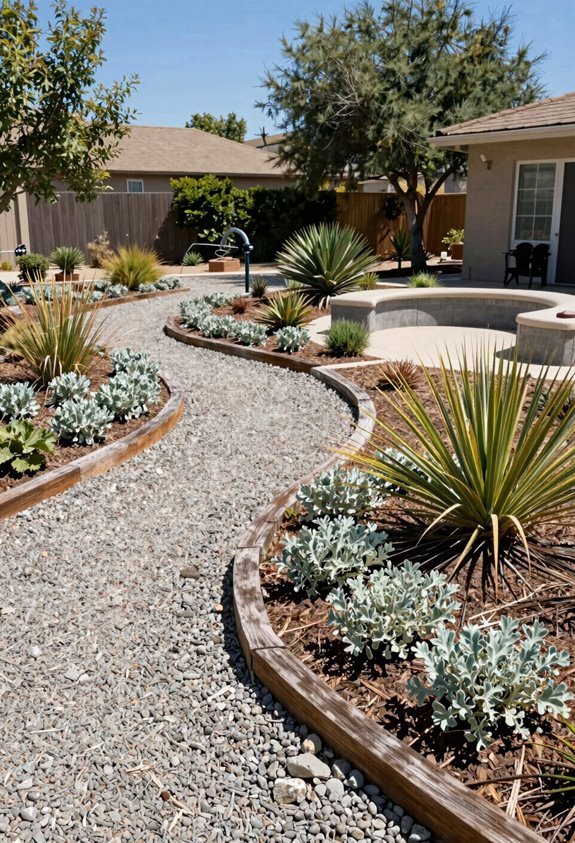
While per-square-foot pricing gives you a useful benchmark, your yard’s overall dimensions ultimately determine the full investment you’ll make. Xeriscaping costs scale dramatically with yard size, and I want you to understand exactly how this works for your space.
| Yard Size | Total Project Cost |
|---|---|
| 500 sq ft | $2,500–$6,250 |
| 1,000 sq ft | $5,000–$12,500 |
| 1,250 sq ft | $6,000–$15,000 |
| 1,500 sq ft | $8,000–$20,000 |
| 2,000 sq ft | $10,000–$25,000 |
Notice how the per-square-foot rate shifts slightly as projects grow? Your design style, materials used, and irrigation complexity layer onto these base figures.
A compact yard keeps your entry point manageable, while expansive 2,000 sq ft properties demand proportionally larger budgets. You’re not alone in navigating this scaling reality.
What Drives Your Xeriscape Cost: Materials, Labor, and Plants
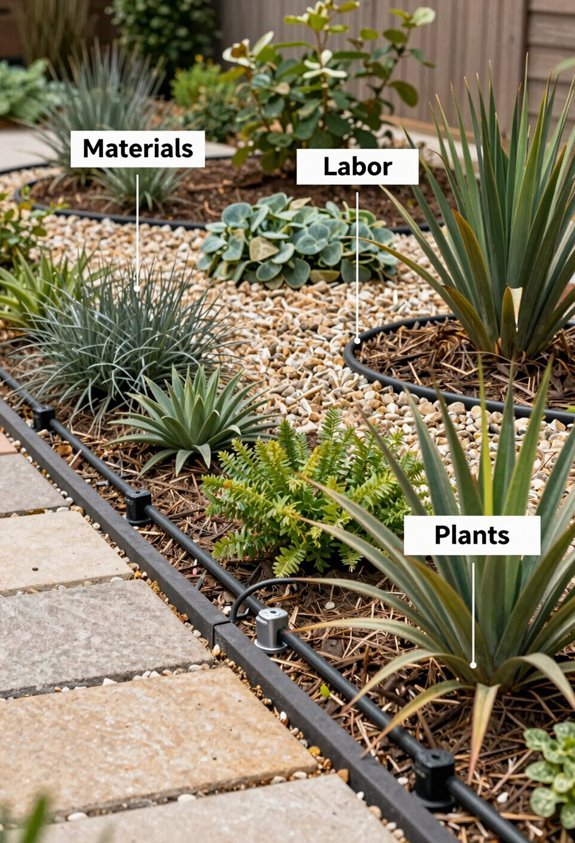
Where exactly does your money go when you xeriscape?
Xeriscaping costs break down into three essentials: materials, labor, and plants. I find labor especially striking, as it runs $50 to $100 per hour for skilled installation. Hardscape choices dramatically shift your budget, since patios and retaining walls push expenses well past simple mulch beds.
For plants, drought-resistant plants create wide ranges, with trees commanding $150 to $1,850 each and shrubs landing at $12 to $90.
Your per square foot price ultimately hinges on density and selection.
- Materials like rock, mulch, and pavers form your baseline investment
- Labor hours accumulate fast during soil prep and placement
- Plant variety determines whether you hit budget-friendly or premium tiers
In Denver, I’ve seen rebates reclaim $1 to $3 per square foot, easing the transition. Smart choices keep you grounded in this welcoming community.
Why Xeriscape Prices Vary by City and Design Choices
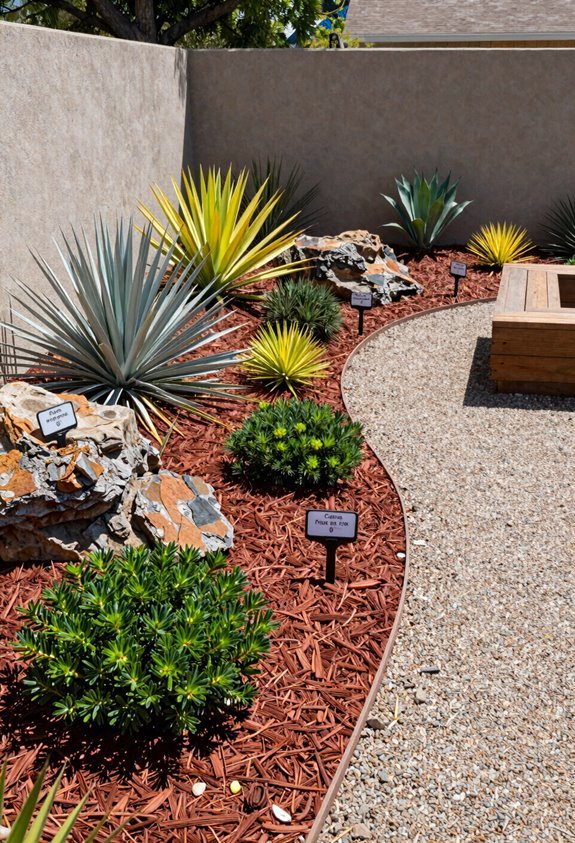
I’ve seen xeriscape quotes swing wildly between cities, and that gap usually traces back to regional labor rates, local material availability, and whether your municipality offers water-efficiency rebates. Your design choices matter just as much. Swapping mulch and native ground covers for imported boulders and mature specimen trees can double your per-square-foot price. Together, these factors explain why a 1,000-square-foot project might run $5,000 in one zip code and $20,000 in another.
Regional Cost Factors
Why does the same xeriscape design cost $8,000 in Phoenix but $14,000 in San Francisco? I’ve seen regional variations create these gaps firsthand. Labor costs swing dramatically between markets, and permits in strict municipalities add hundreds before work begins. Material availability matters too: locally sourced stone cuts expenses, while imported elements inflate budgets.
Your yard size sets baseline price ranges, but regional factors reshape them. I’ve noticed these patterns consistently:
- Labor markets in coastal cities drive 40-60% higher installation rates
- Permit requirements vary from simple notifications to engineered drawings
- Rebates and incentives in drought-prone regions can recover 25-50% of costs
Hardscape choices compound these effects. Where concrete is cheap and skilled masons plentiful, you’ll stretch dollars further. Understanding your local landscape helps you plan realistically.
Design Style Impact
How dramatically can your aesthetic vision reshape your budget? Your chosen style fundamentally alters every cost layer, from per-square-foot materials to total project costs.
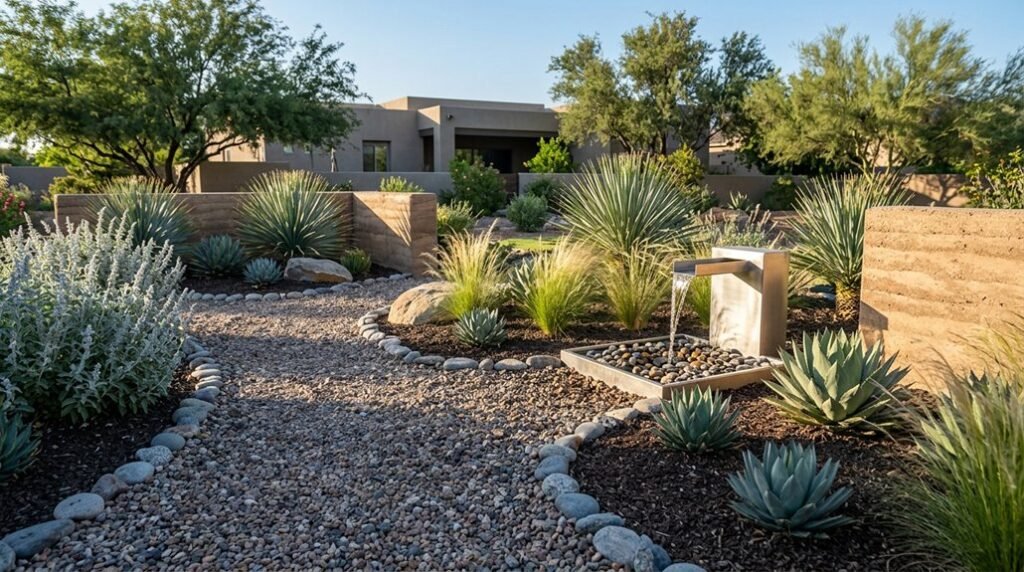
I’ve watched Desert designs run $8,000–$18,500 with sparse Hardscape and native ground covers at $2–$45 per plant. Cottage gardens feel welcoming but demand dense planting, pushing $11,500–$14,000 with layered textures. Modern styles command $11,250–$19,500 through clean lines, architectural Hardscape, and specimen succulents reaching $175 per plant.
Designer fees add $50–$150 hourly, sometimes $200 for technical grading. Your city amplifies these differences through local labor rates and material availability, directly affecting per-square-foot pricing.
Grasping these style-driven variables helps you build realistic expectations, so your xeriscape investment reflects both your aesthetic values and practical boundaries without compromise.
Xeriscaping Cost vs. Lawn Cost: The Long-Term Math
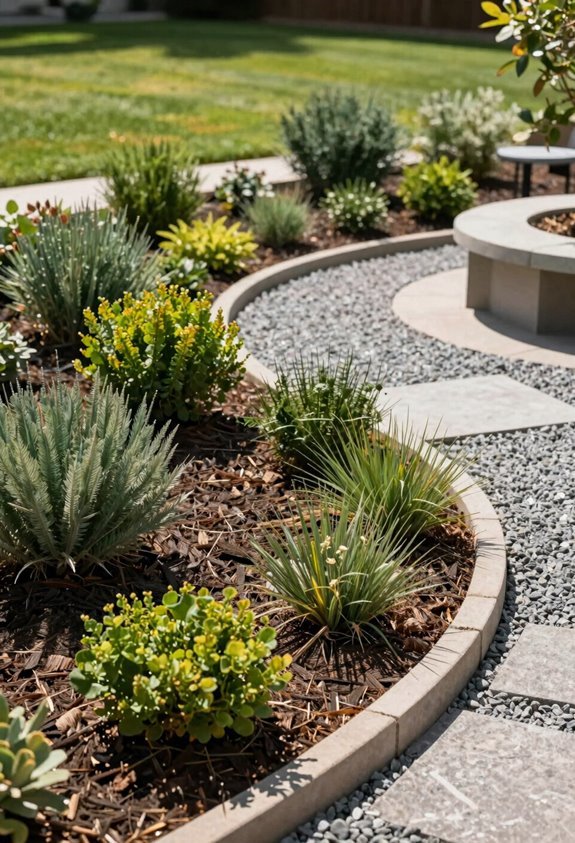
When you crunch the numbers, xeriscaping often wins the long game despite steeper upfront costs. I know that xeriscaping costs ranging from $5 to $20 per square foot feel intimidating, but your upfront investment becomes substantial long-term savings. Your project size determines initial outlay, perhaps $5,000 to $12,500 for 1,000 square feet, yet low-water landscaping delivers measurable return on investment through shrinking water bills and less maintenance.
Consider how traditional lawns drain resources year after year:
- Water bills drop 50-75% once established natives replace thirsty turf
- Less maintenance frees your weekends from mowing and fertilizing
- Property values rise in drought-conscious communities seeking sustainable neighbors
This math works for homeowners committed to smarter living.
How to Cut Xeriscaping Costs Without Losing Quality
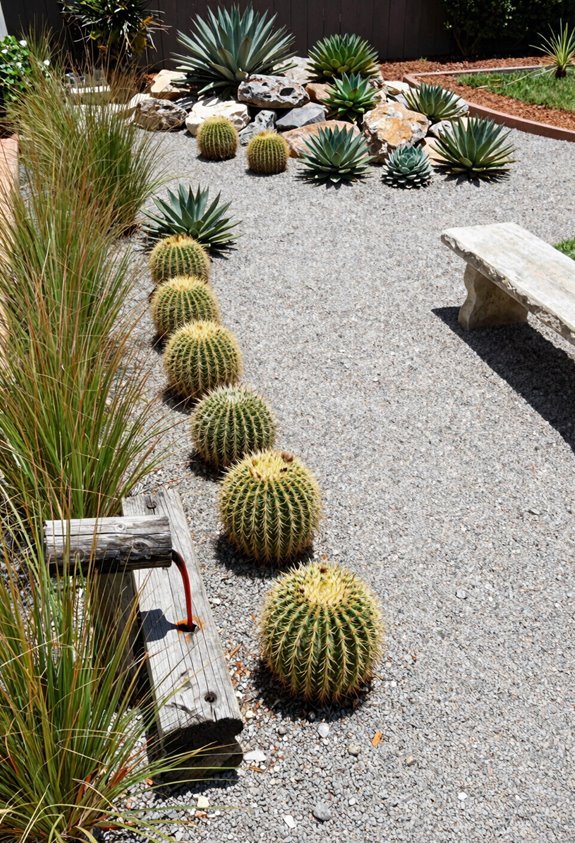
Where can you trim expenses without sacrificing your drought-tolerant vision or long-term functionality? I’ve learned that managing Xeriscaping costs starts with understanding your cost drivers.
I tackle turf removal myself when possible, saving substantial labor costs that typically run $50 to $100 per hour. I space plant density strategically, clustering specimens for visual impact rather than blanketing every square foot. I phase hardscape elements over seasons, prioritizing functional paths before decorative features.
I invest properly in soil prep and drip irrigation upfront because cutting corners here creates expensive problems later. I research rebates diligently; many utilities offer $1 to $3 per square foot for qualifying lawn replacement projects, directly offsetting my investment.
With thoughtful planning, I achieve professional results while keeping my project in that achievable $5 to $12.50 per square foot range.