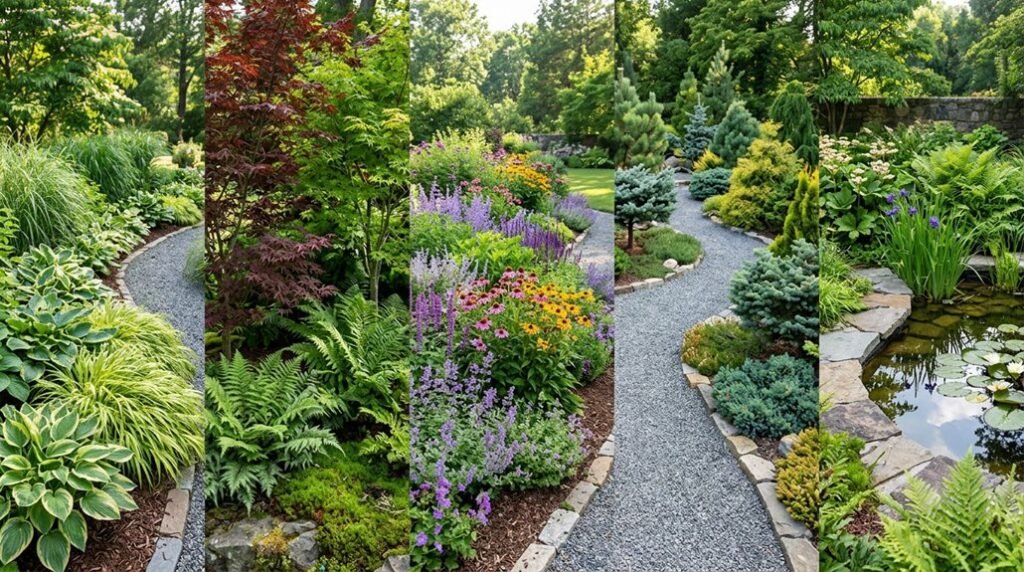
I’ve spent years watching gardens fall flat, and I’ve learned that impact rarely comes from a single striking specimen. It emerges from how plants relate to one another, through deliberate clustering, strategic layering, and thoughtful repetition.
The difference between a collection of plants and a cohesive landscape lies in five specific arrangement techniques I’ll share with you. Each one builds on the last, turning scattered greenery into intentional design. You’ll want to see how these methods work together.
Start With 3-Point Triangle Clusters
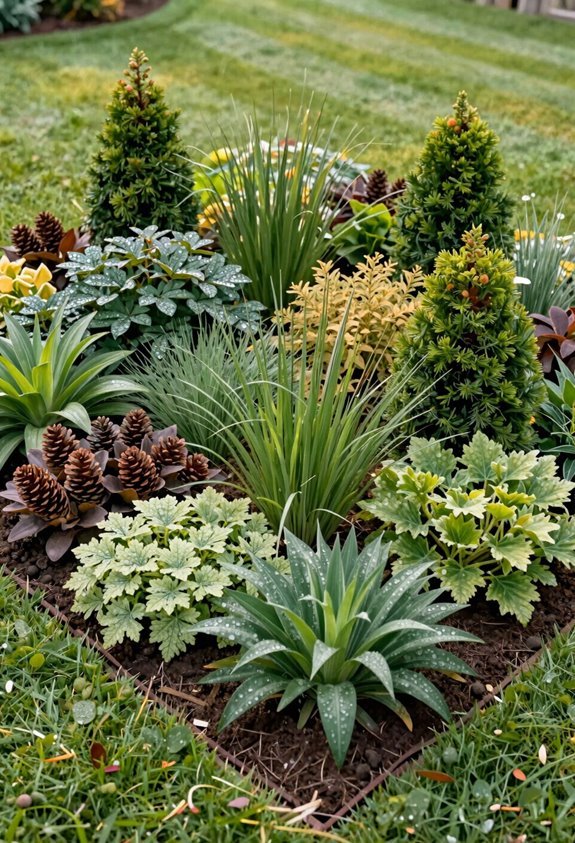
Why does the simplest arrangement often deliver the most reliable results? I’ve found that starting with a 3-point triangle cluster gives you an instant foundation you can build on with confidence. By placing three plants at the vertices of an invisible triangle, you create a cohesive planting that feels intentional yet natural.
I always match plants with complementary height and texture, which preserves each plant’s individual character while unifying the group. This space-efficient design works beautifully in compact gardens, and it establishes a clear focal point that draws the eye without overwhelming the scene. The triangle’s inherent stability supports visual flow and movement throughout your plan.
Once you’ve mastered this technique, you’re ready to expand into more complex layouts that build upon this proven structure.
Add Depth Using 3:2 and 4:1 Arrangements
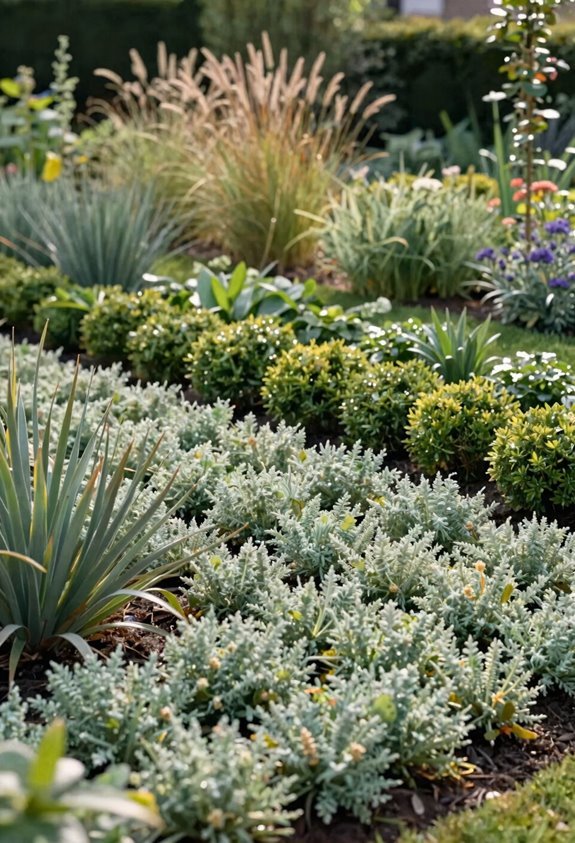
How do you take a simple triangle and transform it into something that commands attention? I start with that 3-point foundation, then add two more plants on the opposite side to create a 3:2 arrangement. This brings depth that wasn’t there before.
I’m building dimensionality through layering, selecting species with different plant height and texture to make the cluster breathe. The original trio maintains cohesion while the additional pair introduces contrast: taller plants toward the back, shorter ones forward, so nothing competes or hides.
This five-plant cluster creates movement you can actually follow with your eye. It works across garden styles because the structure holds. You’re not just planting; you’re composing with intention. That 3:2 arrangement becomes your bridge between basic and bold, between beginner instinct and confident design.
Stack Plants From Ground Cover to Tree Canopy
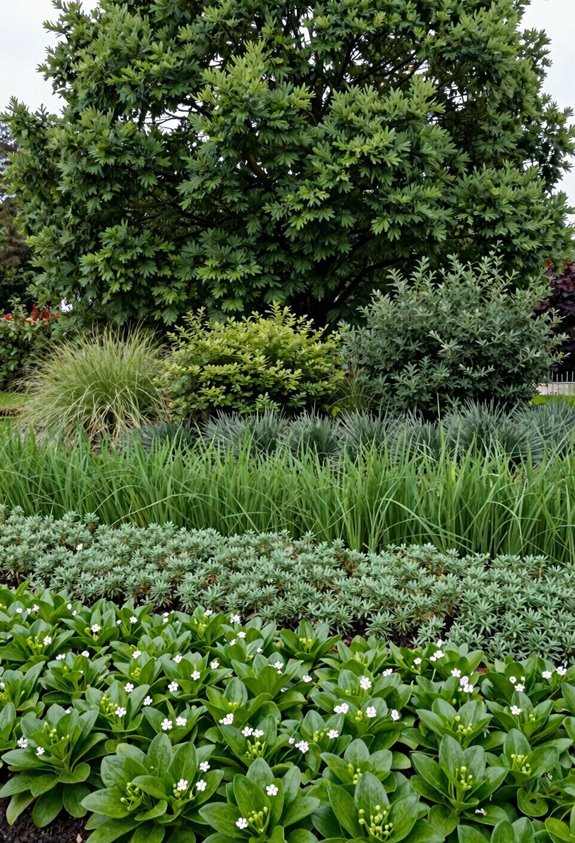
Where do you look when you want a garden to feel complete? I start at the ground cover and build upward, crafting layered planting that transforms flat beds into living architecture. This vertical structure invites you into spaces that feel intentionally designed, not accidentally grown.
I work in four distinct zones: ground cover below six inches, foreground reaching two feet, midground climbing to five, and background anchored by trees and tall shrubs. Within each level, I use massing, clustering plants so they touch at maturity, forming cohesive drifts rather than lonely specimens. You’ll notice how complementary textures and colors create continuous flow from soil to sky.
I place taller species at the rear to preserve sight lines, shorter plants forward for accessibility. For seasonal interest, I mix evergreen anchors with deciduous layers, helping your garden maintain its welcoming structure through every season.
Create Flow With Overlapping Horizontal Masses
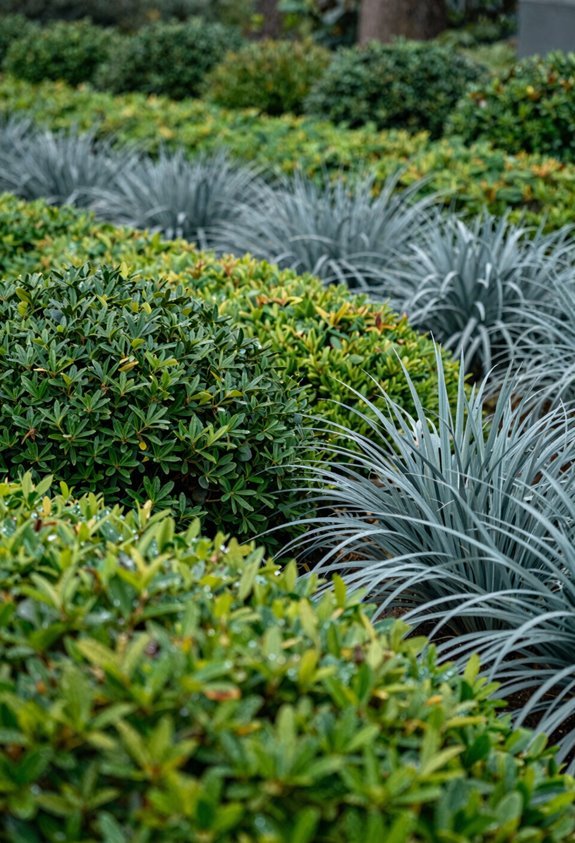
When I’m designing a garden that feels intentional rather than scattered, I rely on overlapping horizontal masses to weave separate beds into one cohesive story. I position plant massing so mature forms touch and interlock, eliminating gaps that break visual flow.
Through horizontal layering, I blend tall background elements with midground and foreground plants, creating seamless transitions. I vary adjacent mass shapes; long and narrow beside short and wide, curved against angular, to generate dynamic, organic movement while maintaining unity.
For depth progression, I place tallest masses along property lines, stepping heights forward to draw the eye through the space. I often stage plants in pots first, verifying overlapping masses will interlock effectively. This approach yields cohesive beds that feel connected and complete.
Unify Your Design With Repeated Colors and Textures
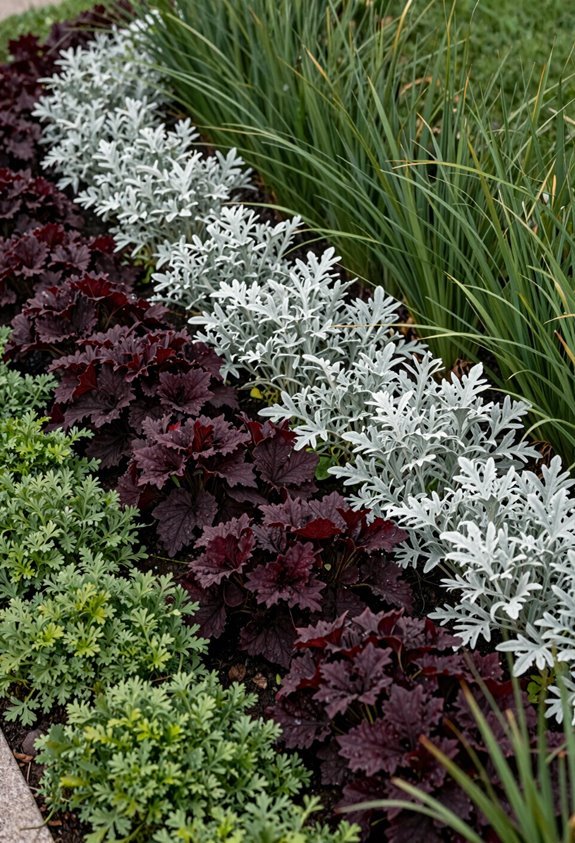
Why do some gardens feel effortlessly harmonious while others seem chaotic, even with similar plants? The secret lies in repetition. When I repeat color throughout multiple beds, I create a cohesive landscape that guides your eye naturally across the space. I don’t scatter random hues; instead, I use massed plantings to distribute tones consistently through layers from front to back.
I plan color flow deliberately, moving from analogous schemes for unity to complementary pops for focal points. I repeat textures too, perhaps spiky grasses or broad-leaved hostas appearing in three distinct areas, to establish recognizable patterns.
This doesn’t mean boring uniformity. I balance these repeated elements with varied companions, creating rhythm without monotony. Your garden becomes familiar, welcoming, and distinctly yours.