I start every garden project with a sun map and soil test, because microclimates dictate what thrives where.
You’ll need to know your light patterns before placing a single shrub.
The real change happens when you layer foliage textures and align paths to horizon lines, creating flow between garden rooms.
Privacy screens frame the experience, while elevated planters solve root-zone problems under mature trees.
Your backyard holds more potential than you realize, and the first step changes everything.
Assess Your Site: Map Sun, Shade, and Soil First
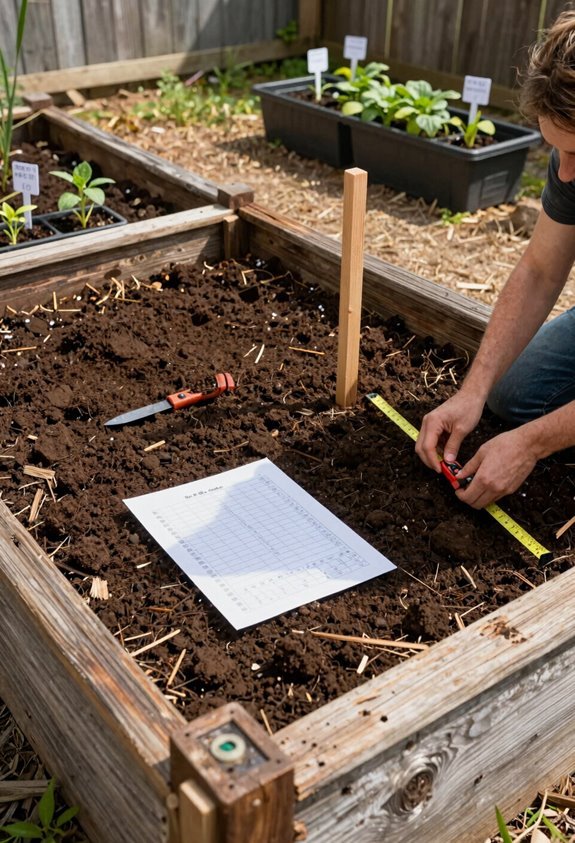
Where do I even begin with a backyard transformation? I start by understanding what I’m actually working with, and I invite you to do the same. I grab a notebook and spend a full day tracking sun exposure across my yard, noting which corners bake at noon and which stay cool beneath the oak. I sketch a simple sun/shade map, marking how shadows from my fence and maple shift through the seasons.
Before I plant anything, I commit to soil testing: digging down, feeling texture, and using a basic kit to check pH and drainage. Clay holds water; sand drains fast. These observations reveal microclimates I’d otherwise miss, and they guide every choice I make next.
Design Garden Rooms With Horizon-Aligned Paths and Patios
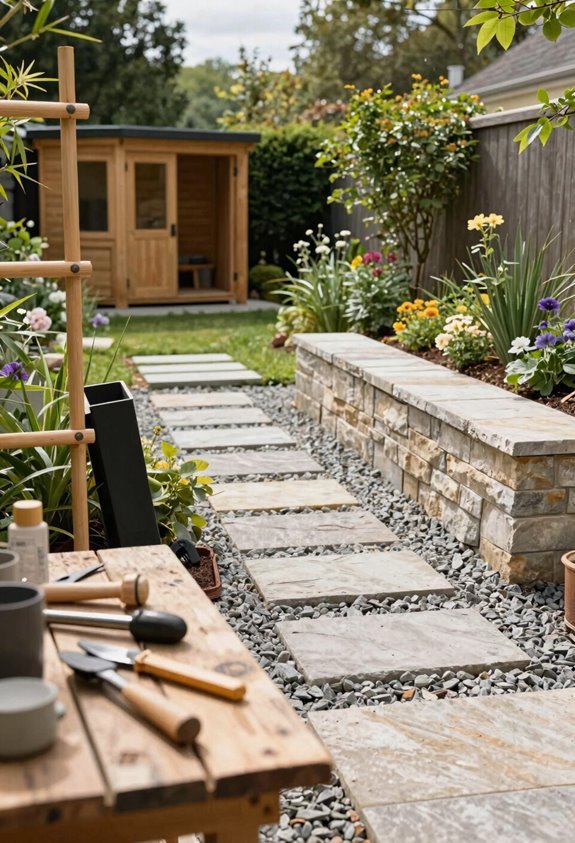
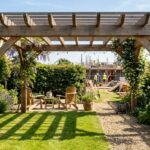
Once I’ve mapped my site conditions, I’m ready to start shaping actual spaces, and that means thinking about how I’ll move through the garden and where I’ll pause. I’ll align my hardscape paths along the horizon line to create clear entry, assembly, and exit points that draw me deeper into the landscape. This horizon-based approach gives my garden rooms real structure.
- Position patios true to the horizon from multiple viewpoints for spatial cohesion
- Create vanishing-point effects that guide movement through sequential rooms
- Use straight lines to define transitions between seating areas and plantings
- Balance hardscape and greenery for rhythmic visual flow
Build a Green Privacy Screen Along Property Lines
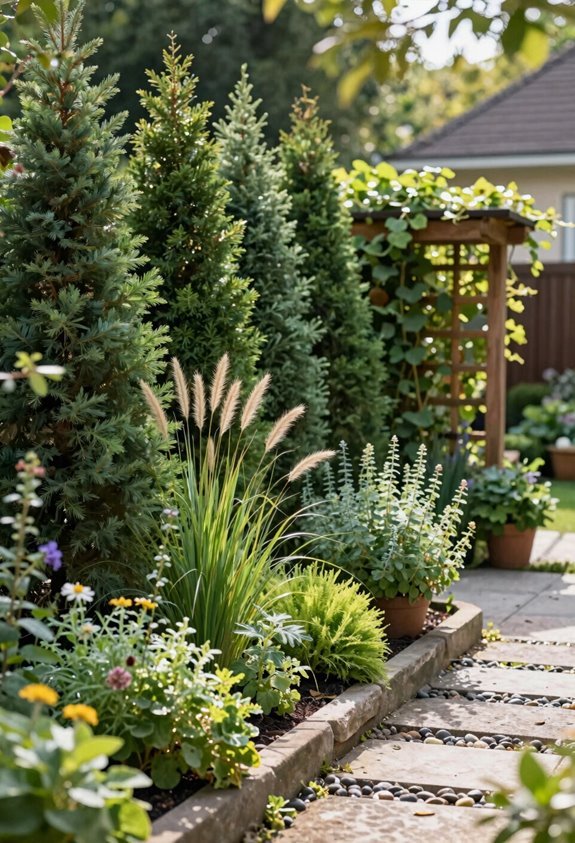
I need a strong vertical element to define my garden’s edge, and Leyland cypress delivers exactly that, forming a dense, evergreen wall that screens unwanted views while setting off everything I plant in front of it.
I’m running my Leyland cypress hedge along the cherry tree toward the western property line and beyond, creating a continuous green privacy screen that filters surrounding views while supporting canopy growth overhead. This living wall establishes rhythm through careful spacing, and I’ve planned density for rapid coverage without gaps.
The deep green backdrop makes my container plantings stand out, giving each pot room to contrast and command attention. I prune regularly, feed the soil, and monitor root competition with adjacent trees and containers. This isn’t just screening; it’s belonging, a defined, intimate space where everything I cultivate grows well.
Plant Foliage-Forward Layers for Dry Shade Under Trees
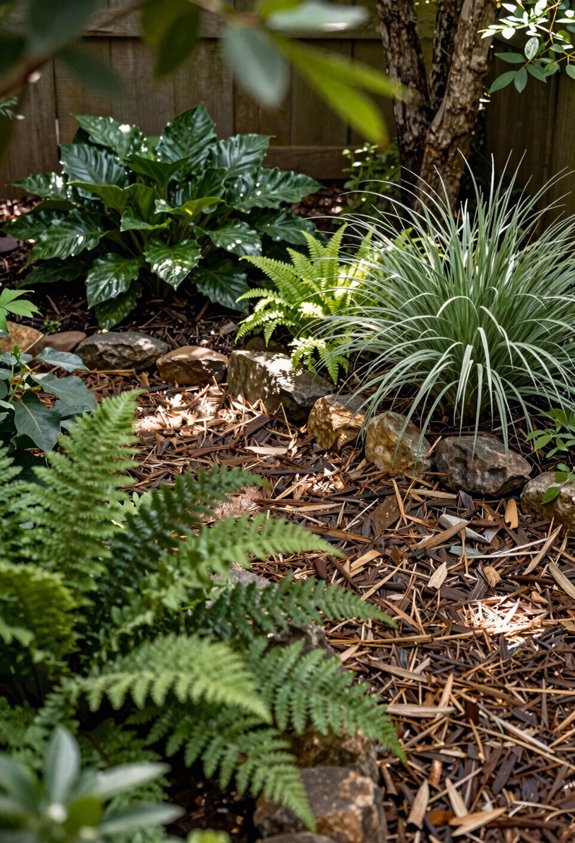
Beneath the Leyland cypress hedge and spreading cherry canopy, dry shade presents a design puzzle that rewards bold thinking. I’ve learned that a foliage-forward approach turns these challenging zones into immersive retreats where leaves, not blooms, carry the visual weight.
Dry shade rewards bold thinking: let leaves, not blooms, carry the visual weight.
My layered garden strategy builds from the ground up:
- Japanese forest grass introduces flowing movement through arching blades that catch filtered light
- Sword-like iris foliage creates vertical punctuation against horizontal spreads
- ‘Wolf Eyes’ dogwood delivers variegated focal impact without demanding flowers
- Coarse butterbur leaves anchor the composition with dramatic scale
I repeat a core plant palette throughout to foster that sense of sanctuary we’re all seeking. Strategic contrasts between fine and bold textures maintain year-round drama, while drought-tolerant natives keep my dry shade investment vigorous with minimal intervention.
Work Around Roots: Use Containers and Elevated Pavers
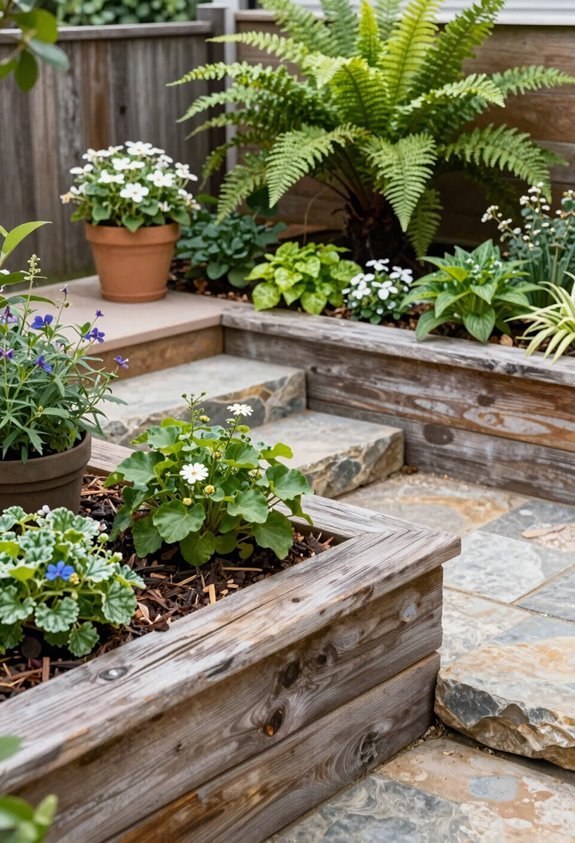
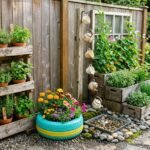
Where can you plant when mature roots have claimed every square inch of workable soil? I’ve found containers transform these impossible zones into spaces that actually work. I elevate pavers of granite or local stone over sensitive root systems, creating stable platforms that protect what’s underground while supporting what sits above.
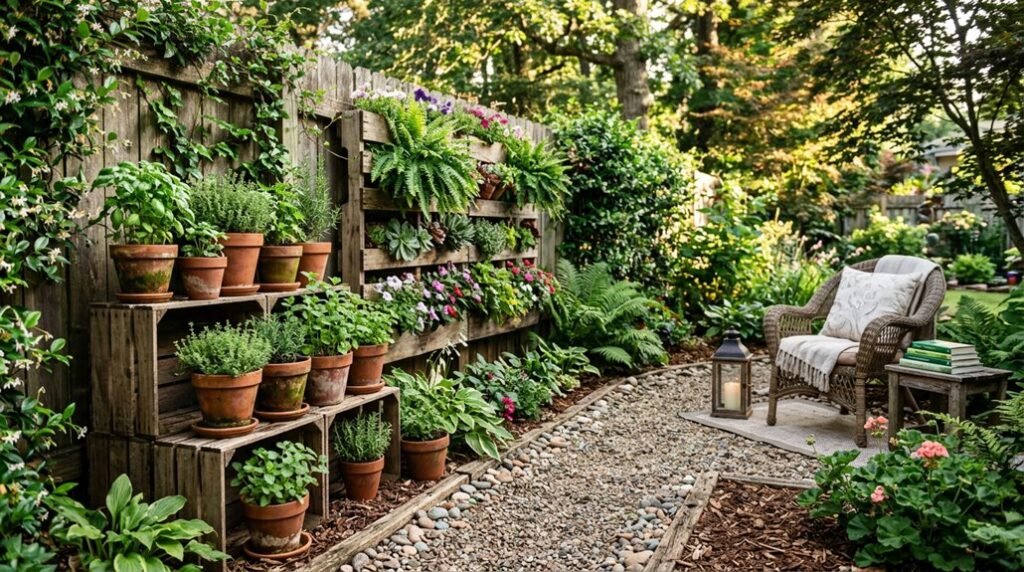
This layered approach lets me arrange drought-tolerant specimens with shallow root systems, think sedums, heucheras, ornamental grasses, around gravel paths and back patios without driving a single shovel into compacted earth. The containers become movable color blocks, shifting with seasons or gatherings.
Elevated pavers do double duty: they define garden rooms through subtle level changes, and they guarantee root protection against foot traffic compression. Together, these elements honor the mature canopy while building your usable outdoor space.
Add Steps and Walkways on Sloped Terrain
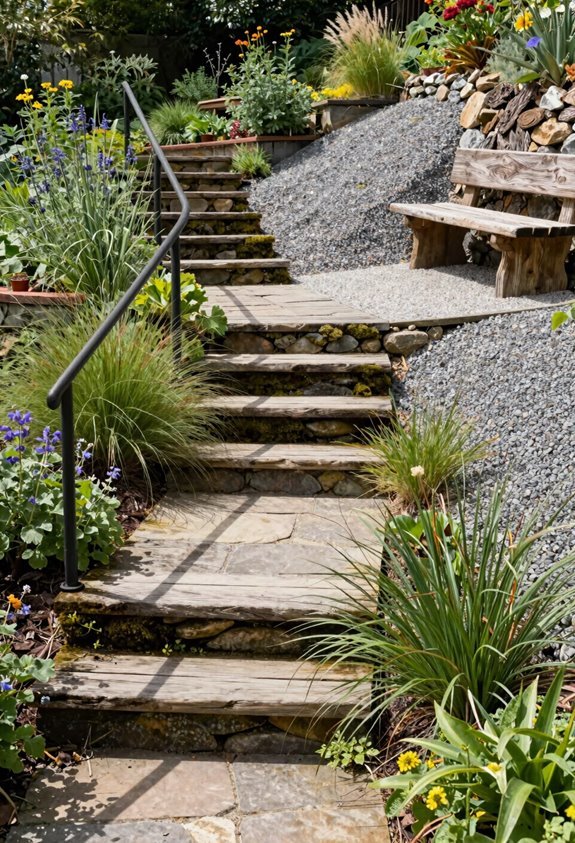
Slopes can feel like wasted territory until you break them into manageable flights. I’ve learned to treat each hillside as a chance to carve deliberate, graceful passage through the terrain.
I size treads at fifteen and a half inches consistently, dividing total rise by six for step count, then build U-shaped boxes from eighteen and twenty-four-inch cuts, lag-screwing fronts flush with sides.
Secure bases with rebar through predrilled holes before checking level. Backfill gaps using soil and pea gravel for drainage and stability. Align each box sequentially, bolting adjacent steps for structural unity. Preserve all cut faces to protect your investment in this outdoor space.
These stairs turn awkward grade into usable space, connecting garden beds while inviting you to use every corner of your property.
Layer Seasonal Blooms That Support Your Leaf Palette
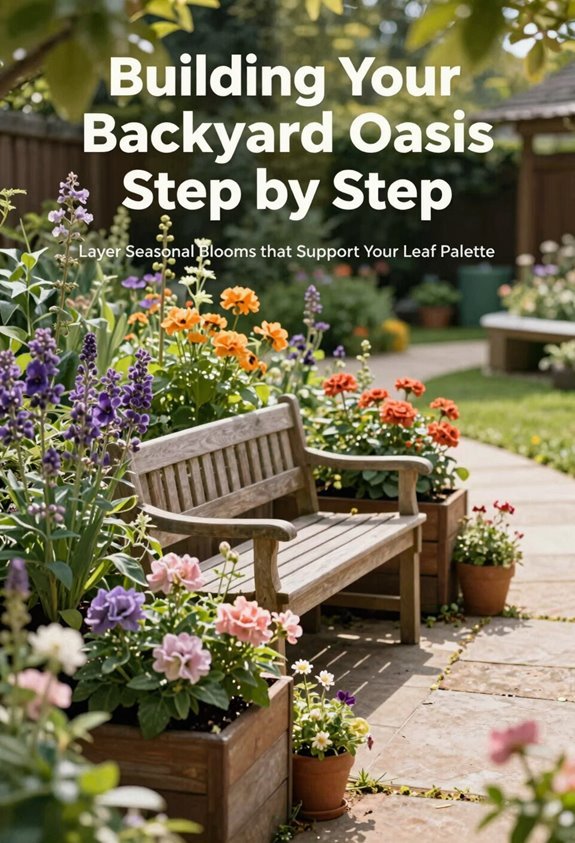
Why treat flowers as the main event when foliage can carry the garden year-round? I’ve built my small space backyard by letting leaves lead and blooms follow.
| Season | Foliage Anchor | Flowering Accent |
|---|---|---|
| Early Spring | Jelena witch hazel | Fothergilla spires |
| Late Spring | ‘Wolf Eyes’ kousa dogwood | Emerging iris blades |
| Mid Summer | Hakonechloa macra sweeps | Martagon lily towers |
| Late Summer | Dense root-competition zones | Strategic focal punctuation |
| Year-Round | Repeated rhythms | Seasonal immersion |
I repeat this cohesive palette so shrubs echo surrounding tones, creating belonging through visual rhythm. Dry shade-tolerant varieties perform reliably under mature canopies, while blossoms punctuate without overwhelming the leaf-driven mood.
You’ll develop color and texture deliberately, never losing structure when petals fade.
Evolve Your Garden as Living Art
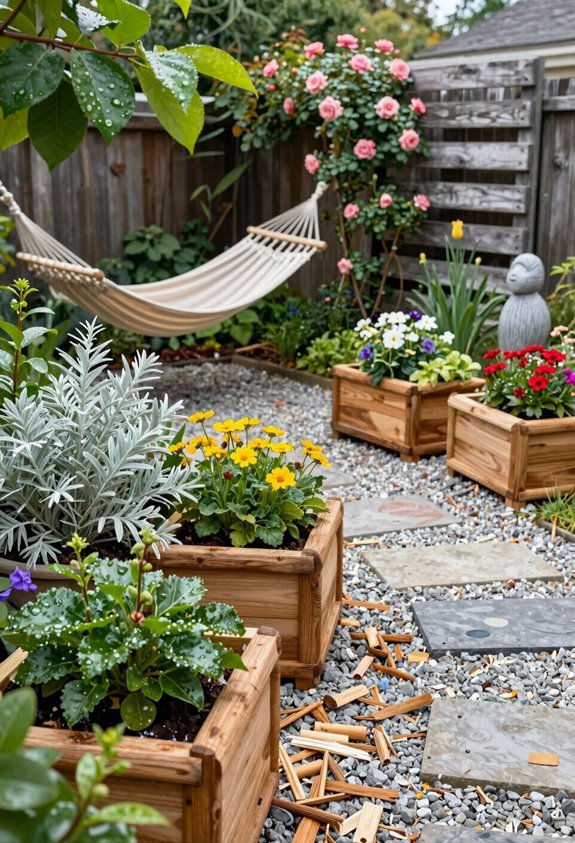
I’ve learned that structure alone won’t sustain a garden’s spirit, so I’m shifting focus toward how the space breathes and transforms over time. My garden becomes living sculpture through deliberate, ongoing change.
I treat new plantings and arrangements as brushstrokes on an evolving canvas, letting my artistic vision guide each seasonal shift. I balance hardscape geometry with soft plant life, using straight lines to anchor intimacy without rigidity.
I select texture-driven performers, Jelena witch hazel, Fothergilla, Martagon lilies, mosses, to sustain visual dialogue year-round. I weave finishing details like alternating terra-cotta and copper tones through the palette, reinforcing cohesion.
Each transformation feeds my creative process. You’re invited to read your own garden’s story as it unfolds, finding belonging in this collaborative art-making between gardener and ground.